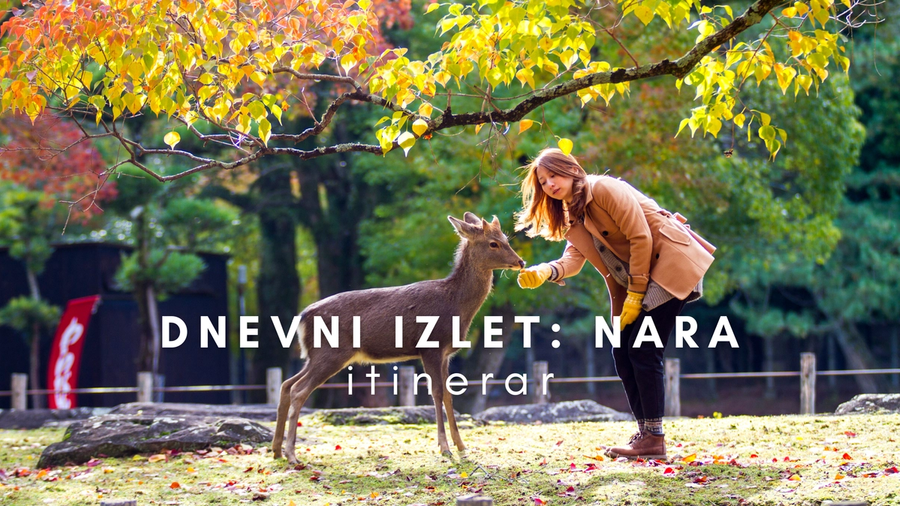
Japan: Nara
This page contains affiliate links. If you buy or book through them I earn a small commission at no extra cost to you. I only recommend things I actually use or would use.
🦌 Nara: one day of temples, deer and matcha
If you're in Osaka or Kyoto and wondering where to hop off to for a day, I really warmly recommend Nara. Historically it was Japan's first permanent capital, and today it's known for its huge Buddhist temples, shrines with thousands of stone lanterns and, of course, its deer. They roam freely all around the park and, according to old Japanese belief, they are messengers of the gods. My trip fell at the beginning of April, and if you're travelling at that time too, I'm keeping my fingers crossed that you catch the cherry blossoms. Below I'm sharing my itinerary with you, with rough times, prices, a few vegan tips for 2026 and ideas for spicing up your day a little if you like.
🚆 Getting to Nara from Osaka or Kyoto
Nara is a great day trip for anyone travelling from Osaka or Kyoto. I recommend catching a train as early as possible to avoid the biggest crowds and, of course, to have as much time as possible for exploring. When it comes to trains, let Google be your friend, as all departures, prices and platforms are described in great detail, but I'm still adding a few travel tips below:
🚆 From Osaka
🚉 From: Osaka Station (JR)
🚉 To: JR Nara Station (direct JR Yamatoji Rapid line, no changes)
⏱️ Journey time: approx. 50 min
💴 Price: ~800–840 ¥ one way or included in the JR Pass
👉 If you don't have a JR Pass or Namba is closer for you, you can also take the Kintetsu line from Osaka-Namba station to Kintetsu-Nara (around 40 min, ~680 ¥). This station is a bit closer to the park, but my itinerary is set up from the JR station, so the walking times below are calculated from there.
🚆 From Kyoto
🚉 From: Kyoto Station (JR)
🚉 To: JR Nara Station (direct JR Nara Line, Miyakoji Rapid express train, no changes)
⏱️ Journey time: approx. 45 min (trains run roughly every 30 minutes)
💴 Price: ~720 ¥ one way or included in the JR Pass
What about getting around in town? Nara is compact enough that you can walk almost all of it, so you don't need a bus or a taxi. Just be prepared for quite a few kilometres of walking, so put on comfortable shoes.
This content comes from a third-party provider that may set its own cookies and collect data about your visit. We only load it with your consent. More about privacy
📝 Basic tips before you go
Crowds: In recent years Nara Park has become one of the most overrun places, so an early start is worth its weight in gold, especially if you go at the weekend or during holidays. Until 10 am the park is still surprisingly quiet, but after that your photos start filling up with other tourists' heads 😅
Cash: Most of the bigger sights accept cards, but for smaller stalls with local food and entrance fees to the smaller shrines, a few coins will come in very handy.
Before we get to the itinerary, of course, one more thing: the deer
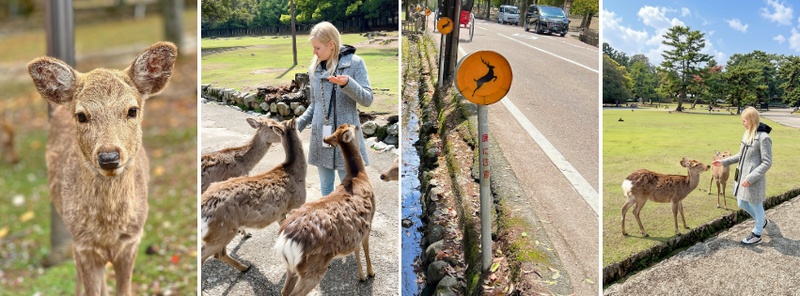
🦌 There are supposedly around 1,300 deer roaming around town and begging for snacks. They really are connoisseurs of Japanese etiquette, because they ask for crackers by bowing. Yes, no joke, bow to them and they'll bow back.
🍎 Do NOT feed the deer with food you have brought with you (even if it's fruit or vegetables, let alone bread, sweets or snacks). It doesn't suit their digestion and can seriously harm them. That's why there are signs around the park asking you not to feed them any other food. Since they try to eat almost anything they see, also watch out for plastic bags and paper and make sure you hide them well.
🍘 Special biscuits for them (shika senbei) are sold at stalls around the park for around 200 ¥ per pack. If you buy them, be prepared to be surrounded by a whole crowd before long.
⚠️ The deer are quite persistent – they tug at clothes, bags and any cables hanging out of your bag, so keep an eye on your things. Some deer are super friendly, others are a bit aggressive, so be careful. Hold the biscuits up high so they can see them and don't hide them. If possible, tuck away paper maps and tickets so the deer don't mistake them for a snack.
🚫 Don't show food if you don't intend to give it to them. Even when you run out of crackers, show your empty hands. It's also important that we stay calm the whole time and don't run away or scare them.
There you go, we've covered the main technical stuff, and now comes the itinerary for a one-day trip around Nara.
This content comes from a third-party provider that may set its own cookies and collect data about your visit. We only load it with your consent. More about privacy
🏯 Kofuku-ji (~8:15)
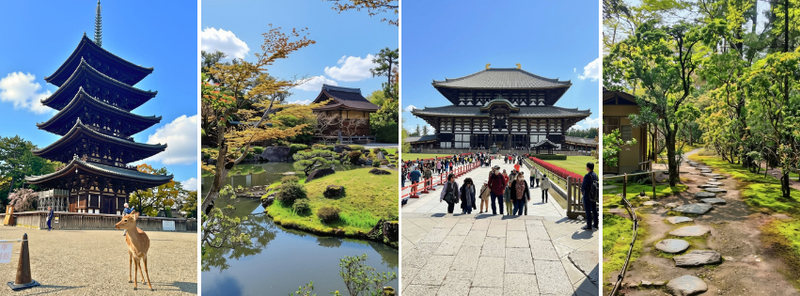
From JR Nara station I walked in about 13 minutes to the first stop, Kofuku-ji temple. It was founded in 710 and for centuries was the family temple of one of the most powerful noble families in Japan, the Fujiwara family. The five-storey pagoda is around 50 metres tall, making it the second tallest in Japan, so despite the restoration it's one of the icons of the city. In the morning the area around the temple is still almost empty, and by the Sarusawa pond you'll almost certainly be greeted by your first deer.
At such an early hour it's really loveliest here, because you have the complex almost to yourself. If you're interested in Buddhist art, it's also worth going into the National Treasure Museum, which houses famous wooden statues.
- 🕒 Opening hours: the temple grounds are freely accessible, National Treasure Museum 9:00–17:00 (last entry 16:45)
- 💴 Admission: the grounds are free, Eastern Golden Hall ~500 ¥, museum ~700 ¥, combined ticket ~900 ¥
- ⏱️ Recommended time: 45–60 min
- ⚠️Heads up: in 2026 the pagoda is mostly hidden behind scaffolding because of restoration (until 2033, according to the latest information), so don't count on the classic postcard photo.
🌿 Yoshikien Garden and Isui-en (~9:30)
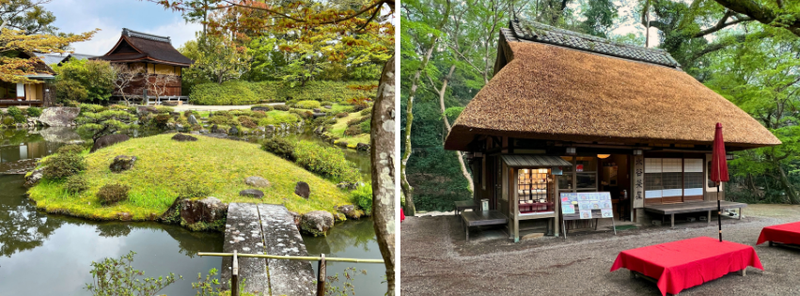
Approx. 10 minutes of walking and we're already at Yoshikien Garden, a Japanese garden divided into three parts: a pond garden, a moss garden and a tea flower garden. It is designed so that the hills in the background seem like part of the garden (the technique is called shakkei, "borrowed scenery"), which makes it one of those corners where you really calm down after a morning stroll among the crowds. Entry is usually free for foreign tourists (take your passport with you, and check the current conditions just in case).
Right next door there's another garden, Isui-en with the Neiraku Museum of Art. It consists of two parts, an older one from the 17th century and a younger one from the early 20th century, and here too the hills behind Kasuga shrine are incorporated into the design. The ticket also includes the neighbouring museum with Chinese and Korean ceramics and bronzes. If you have time and the tea house tempts you, for a few hundred yen you can enjoy a cup of matcha and take in the view.
- 🕒 Opening hours: Isui-en approx. 9:30–16:30 (check the days, as it's usually closed one day a week)
- 💴 Admission: Yoshikien usually free for foreigners, Isui-en with the museum ~1,200 ¥, matcha in the tea house approx. 850 ¥
- ⏱️ Recommended time: 1–1.5 hours for both gardens together
🦌 Todai-ji and a stroll through Nara Deer Park (~11:00)
From the gardens you head towards Todai-ji temple. It houses the Daibutsuden, one of the largest wooden buildings in the world, and inside it a 15-metre-tall bronze Buddha. The entrance is guarded by two huge wooden guardians in the great Nandaimon gate, which are worth stopping for and a pile of photos. This time I just walked past, because I wanted more time for the park and Kasuga shrine, but if you haven't seen the Great Buddha yet, I recommend taking half an hour and going inside, because the sheer size is something that's hard to describe with photographs.
Then we head through Nara Deer Park, which is freely accessible 24 hours a day. Here you wander across meadows, among old trees and stone lanterns, and the deer accompany you every step of the way. If you feel like some exercise, you can climb up to Nigatsu-do hall, which offers a lovely view of the city.
- 🕒 Opening hours: the park is open 24/7; Todai-ji approx. 7:30–17:30 in summer, approx. 8:00–17:00 in winter
- 💴 Admission: park free, deer biscuits ~200 ¥, Daibutsuden ~800 ¥
- ⏱️ Recommended time: 1.5 hours; 2 hours with entry to Todai-ji
🍜 Lunchtime: vegan options (~12:30)
Lunch is of course the most important time of the day for us foodies. When I first went to Japan, there were quite a few fewer vegan options in Nara and I could barely find anything for myself. While writing this blog I opened the Happy Cow app just for fun, to see whether my saved restaurants are still open, and I spotted a huge number of new food places, including some that are completely vegetarian or vegan. So I believe you won't have any trouble finding something. Here is also the link to Happy Cow, where you can browse the vegan offerings, look at photos and read visitors' reviews: Happy Cow - Nara
⛩️ Kasuga-taisha (~13:45)
After lunch it's time for Kasuga-taisha, in my opinion the most beautiful shrine in Nara. It was founded in 768, and the path to the shrine is lined with centuries-old cedars and thousands of stone lanterns, which give you the feeling that you're walking through an enchanted forest. They say it's even more magical when the lanterns are lit twice a year (at the Setsubun Mantoro festival on 3 February and in summer on 14 and 15 August). But even if that's not when you're travelling, a walk through the shady forest is wonderful, tried and tested.
The outer part of the shrine is free, and to enter the inner corridor with the bronze lanterns you pay an extra ~500 ¥. It was worth it for me, because in nice weather you see a lovely combination of green trees and orange wood, and on the way you're accompanied by deer, which are especially beloved in this part.
- 🕒 Opening hours: approx. 6:00–18:00 in summer and slightly shorter in winter
- 💴 Admission: outer area free, inner part ~500 ¥
- ⏱️ Recommended time: 1–1.5 hours
🍦 Ice cream and Sagiike Pond (~15:15)
After quite a lot of walking, it's time for something sweet. In the southern part of the park, on the way back towards the station, stands Tsuru-no-chaya, known for its ice cream, which they make in regular and vegan flavours. Vegan or not, grab an ice cream and plop down somewhere in the shade (or in the sun, if you're there in the cooler season), where the deer will keep watching you with very covetous looks.
Nearby there's also Sagiike Pond, a peaceful pond with a lovely view, in which a small pavilion is reflected, perfect for photos or a few minutes' pause when your feet tell you it's enough.
- ⏱️ Recommended time: 30–45 min
🛍️ Higashimuki and Mochiidono (~16:15)
On the way back towards the station, swing by a small park and then to two covered shopping streets: Higashimuki and Mochiidono. Here you'll find little shops with souvenirs, tea, Japanese stationery, ceramics and loads of sweets typical of Nara. Higashimuki is also home to a famous mochi shop, where you can sometimes even see the actual pounding of rice at a proper fast rhythm. Mochi is mostly vegan, but some flavours are filled with cream, so for all vegan readers, it's better to ask about the ingredients before you buy. The Japanese mochi classic is red bean paste (anko), which is plant-based.
🍡 Show-stopping mochi shop: Nakatanidou. If you've ever seen two men on YouTube or TikTok pounding green mochi extra fast and shouting with every strike, then you know what I'm talking about. Nakatanidou is famous as one of the fastest mochi pounders in Japan and, according to several sources, has won the national mochi-pounding competition more than once. Their speciality is yomogi mochi, that is, green mugwort mochi filled with sweet red bean paste, which is dusted with kinako - roasted soy flour. The shop stands on the main street between Kintetsu-Nara station and the park (around 5 minutes' walk south of Kintetsu-Nara station), so it's right on your way.
- 🕒 Opening hours: approx. 10:00–18:00, closed on Tuesdays (check on the official website nakatanidou.jp or Instagram, as it changes around holidays)
- 💴 Price: around 200 ¥ per piece
- 👉 Tip: The pounding time isn't set in advance, as they pound mochi depending on how fast it's selling, so you can't catch an exact time slot. If it's crowded, come a little before or after the classic lunch hours. And eat the mochi straight away, because it's INSANELY good when it's still fresh.
🍵 Additional activities: Klook, tea ceremony and more
If you have more time planned or want to spice up the day a bit, here are some ideas I found on Klook and other sites. Online offers change, so always check the current price and dates before booking.
- 🍵 Tea ceremony: popular experiences with traditional matcha, led by a tea master with explanations in English. Suitable for beginners too.
- 🏡 Tea ceremony in Naramachi: you can experience it in a traditional house in the historic Naramachi district, just south of Kofuku-ji temple. It includes matcha, Japanese sweets and an explanation of etiquette. The price in past years was around 5,000 ¥, so check the current one.
- 👘 Kimono rental or guided tours: if you're interested in more experiences, you can find them on Klook.
- 🐠 Nara Kingyo Museum and Nara Ikimono Museum: if you're after something a little different from temples, or if you get caught in the rain, this is a colourful and soothing idea for a visit. Allow 1–2 hours. The ticket on Klook is a combined ticket that includes both museums - check the opening hours and last entry.
This content comes from a third-party provider that may set its own cookies and collect data about your visit. We only load it with your consent. More about privacy
⭐ To finish
I know many of you picture only deer when you think of Nara, but then you discover a whole bunch of temples, gardens, good food and traditional little streets. It's great that everything is very close together, so in one day you can see practically all the main things without rushing.
Thanks for reading this blog, and happy travels! 🦌
Welcome
Eva Susin
From cooking workshops to discovering vegan corners around the world — food is my biggest passion and brings all my interests together. If you need inspiration for your next meal, have a browse through the recipes. The content might just give you some cravings 😉